
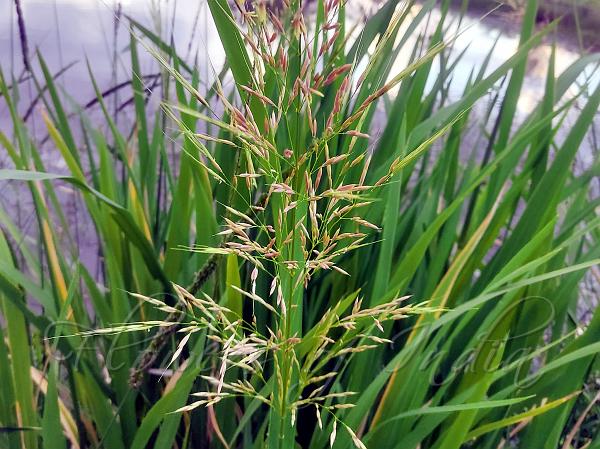
| Manchurian Wild Rice |

|
 |

|


| File size | 973081 |
| Original date | 7/12/26 1:19 PM |
| Resolution | 2048 x 1536 |
| Flash | Flash did not fire, auto |
| Focal length | 4.71mm |
| Exposure time | 1/423s |
| Aperture | 1.7 |
| Focus Distance | |
| Metering Mode | Center weighted average |
| Camera make | OPPO |
| Camera model | OPPO F21s Pro |
| Sensor type | MonochromeArea |
 |
 ative ative |
 |
 |
 |
Photo: |
Botanical name: Zizania latifolia Family: Poaceae (Grass family)
Synonyms: Zizania aquatica var. latifolia, Zizania dahurica
Synonyms: Zizania aquatica var. latifolia, Zizania dahurica
Manchurian wild rice is a perennial, herb with stems
erect, 1-2.5 m, about 1 cm thick, rooting at lower nodes. Leaf sheaths
are longer than internodes, thickened, lower sheaths tessellate; leaf
blades broadly linear, 50-90 x 1.5-3.5 cm, lower surface scabrous,
upper surface hairless, tapering to base, tip abruptly narrowed to a
long point. Flowers are born in panicle 30-50 x 10-15 cm, lower
branches with male spikelets, upper branches with female spikelets,
middle branches mixed; branches semiwhorled, many at each node,
sparsely spinulose; flower-stalk tip disk-shaped with spinulose margin.
Male spikelet 0.8-1.5 cm; lemma elliptic-oblong, margin fringed with
hairs; awn 2-8 mm, scabrous; anthers 5-8 mm. Female spikelet 1.5-2.5
cm; lemma linear, scabrous on veins; awn 1.5-3 cm, scabrous. It is
cultivated as a vegetable in Manipur and China. The young shoots and
rhizomes are edible when infected, swollen, and softened by the fungus
Ustilago esculenta. The grains were used for food by the Emperor
in ancient China, and are currently being used by fishermen. Manchurian
wild rice is found in NE India to SE Siberia and East Asia, in shallow
water of lake margins and swamps, forming large patches. Flowering:
June-September.
Medicinal uses: Rhizome paste applied to
burns. Infected fruit is rich in protein. In china the culms, rhizomes
and grains are used against anaemia, fever and as a diuretic. Also used
for heart, kidney and liver problems.
Rhizome paste applied to
burns. Infected fruit is rich in protein. In china the culms, rhizomes
and grains are used against anaemia, fever and as a diuretic. Also used
for heart, kidney and liver problems.
Medicinal uses:
Rhizome paste applied to
burns. Infected fruit is rich in protein. In china the culms, rhizomes
and grains are used against anaemia, fever and as a diuretic. Also used
for heart, kidney and liver problems. | Identification credit: Naorem Sujata | Photographed in Imphal, Manipur. |
• Is this flower misidentified? If yes,